Onafhankelijk Advies in Supply Chain & Digitale Transformatie

Danny Gaethofs doorbreekt de ruis rondom digitale transformatie. Als adviseur verbind ik uw upstream en downstream supply chain‑strategie aan de juiste architectuur en enterprise‑systemen. Geen leverancierspraatjes, maar senior regie die miljoenenverliezen bij implementaties voorkomt.

Actuele ontwikkelingen in enterprise technology

AI verandert de enterprise-omgeving snel. Ik analyseer wat dat in de praktijk betekent voor ERP, supply chain, architectuur, processen, leiderschap en verantwoordelijkheid.

Dossier Artificial Intelligence (AI)

Showing posts with label composable architecture. Show all posts

Kingfisher unintentionally shows that Clean Core does not work without composable

Kingfisher says “no” to SAP S/4HANA. But look closer and the story changes. This is not a rejection of SAP at all. It is a confrontation with the limits of organisational maturity: processes, data, extensibility and governance.

Kingfisher is not an incident.It is a signal.

It shows that the classical ERP implementation logic — one system, one truth, one roadmap — structurally clashes with the scale, diversity and change pressure of modern multinationals.

The problem is not SAP.
The problem is how we still implement ERP.

As if one standard could fit organisations in the same sector, while each country and market operates under different rules.

This does not require a tighter blueprint.
It requires an architecture that facilitates instead of forces.
An architecture that can carry variation without breaking the organisation.

This is the point: it is not about ERP, it is about architecture.

Clean Core is often presented as the solution: less customisation, more standardisation, but it is more than that.

Clean Core combines technology and governance and creates a framework in which variation can exist in a controlled way.

Without composable, Clean Core becomes a constraint.
With composable, Clean Core becomes a strategy.

That is when it becomes clear why “composable” is not a hype, but a deliberate design choice in a landscape that would otherwise grind to a halt.

And then Kingfisher.

This is where nuance matters.

Chris Blatchford told SAP they were too expensive and that he wanted to see the value SAP would deliver for that price.

But what is striking is that this goes public after Kingfisher had already committed to a composable route two years earlier:

  • Optimizely: DXP
  • Fluent Commerce: OMS
  • Google Cloud: data, AI, ML
  • Databricks: analytics, ML
  • Conversational bots: outside SAP

What remains are the classical modules: WMS, sales, procurement, planning.
However, the strategic choice has already been made.

Variation has been moved outside SAP.
The core has already been relieved.

So when Blatchford now says SAP is too expensive, it does not feel like a negotiation, more like a rationalisation after the fact.

Kingfisher does not prove that SAP is falling short.
Kingfisher proves that Clean Core cannot exist without composable.

And it shows that organisations for which variation is a structural reality — whether they say it out loud or not — must organise their landscape outside the core if they want to move forward at all.

Not because they are so mature.
Not because they are so strategic.
But because the reality of their business forces them to.

Composable is not a hype.
It is the architecture that prevents Clean Core from becoming polluted again.
This is an architectural choice that becomes inevitable the moment you stop fooling yourself.

And yes, composable is level D of the SAP Clean Core Extensibility Framework.

Kingfisher bewijst onbedoeld dat Clean Core zonder composable niet werkt

Kingfisher zegt “nee” tegen SAP S/4HANA.
Maar wie goed kijkt, ziet dat Kingfisher SAP helemaal niet afwijst. Het botst op de grenzen van zijn eigen volwassenheid: processen, data, uitbreidbaarheid en governance.

Kingfisher is geen incident. Het is een signaal.

Het laat zien dat de klassieke ERP‑implementatielogica — één systeem, één waarheid, één roadmap — structureel botst met de schaal, diversiteit en veranderdruk van moderne multinationals.

Het probleem is niet SAP.
Het probleem is hoe we ERP nog steeds implementeren.

Alsof één standaard past op organisaties die toevallig in dezelfde sector opereren, maar per land en markt onder andere spelregels vallen.

Dat vraagt geen strakkere blauwdruk.
Dat vraagt een architectuur die faciliteert in plaats van dwingt.
Een architectuur die variatie kan dragen zonder de organisatie te breken.

Hier draait het om: niet ERP, maar architectuur.

Clean Core wordt vaak gepresenteerd als de oplossing, minder maatwerk, meer standaard.
Maar het is meer dan dat.

Clean Core combineert technologie en governance en creëert een kader waarin variatie gecontroleerd kan bestaan.

Zonder composable wordt Clean Core een beperking.
Met composable wordt Clean Core een strategie.

Dan wordt duidelijk waarom “composable” geen hype is, maar een bewuste ontwerpkeuze op een landschap dat anders vastloopt.

En dan Kingfisher

Hier moet de nuance scherp blijven.

Chris Blatchford zei tegen SAP dat ze te duur waren en dat hij graag de waarde wilde zien die SAP daarvoor zou leveren.

Interessant is vooral de timing: dit komt naar buiten terwijl Kingfisher de composable‑route al twee jaar eerder had ingezet:

  • Optimizely: DXP
  • Fluent Commerce: OMS
  • Google Cloud: data, AI, ML
  • Databricks: analytics, ML
  • Conversational bots: buiten SAP

Wat openstaat, zijn de klassieke modules: WMS, verkoop, inkoop, planning.
Maar de strategische keuze is gemaakt.

De variatie is al buiten SAP geplaatst.
De core is al ontlast.

Dus wanneer Blatchford nu roept dat SAP te duur is, voelt dat niet als een onderhandeling — maar als een rationalisatie achteraf.

Kingfisher bewijst niet dat SAP tekortschiet.
Kingfisher bewijst dat Clean Core zonder composable niet bestaat.

En het laat zien dat organisaties die variatie serieus nemen — of ze dat nu hardop zeggen of niet — hun landschap buiten de core moeten organiseren om überhaupt vooruit te kunnen.

Niet omdat ze zo volwassen zijn.
Niet omdat ze zo strategisch zijn.
Maar omdat de realiteit van hun business dat afdwingt.

Composable is geen hype.
Het is de architectuur die voorkomt dat Clean Core opnieuw vervuilt.
Het is de structuur die Clean Core mogelijk maakt.

Dit is geen technologiediscussie.
Dit is een architectuurkeuze die onvermijdelijk wordt zodra je stopt met jezelf voor de gek houden.

En composable is level D van het SAP Clean Core Extensibility Framework.

Composable als ontwerpkeuze binnen Clean Core

Veel organisaties zien Clean Core en Composable als tegenpolen.
Dat is een misvatting.
Alsof je moet kiezen.

De vraag is nooit of je Composable nodig hebt, maar waar het moet landen in een landschap dat anders vastloopt.

Clean Core is een technische discipline.
Ze beschermt de kern tegen verstarring.
Ze maakt upgrades, stabiliteit en innovatie mogelijk.

Maar Clean Core ontwerpt het landschap niet.
Dat is primair een vraagstuk van business-architectuur, niet van technologie.

Het biedt geen antwoord op:

  • • hoe variatie structureel wordt gedragen
  • • waar processen mogen divergeren
  • • hoe integratie schaalbaar blijft
  • • hoe verandering gefaseerd kan plaatsvinden

Precies daar wordt composable relevant.

Niet als alternatief voor de kern.
Niet als ontsnapping uit het leveranciersdomein.
En zeker niet als hype.

Composable is — in deze context — een bewuste ontwerpkeuze binnen een Clean Core-benadering.

Je hoeft niet buiten het portfolio van je leverancier te kijken.
Het mag wel, wanneer elders betere oplossingen zijn die geen structurele frictie introduceren.

Voor multinationals is dit geen luxe.
Het is vaak de enige haalbare route.

Omdat hun landschap:

  • • te groot is om in één beweging te veranderen
  • • te divers is om volledig te standaardiseren
  • • te verweven is om te “resetten”

Composable maakt het mogelijk om te transformeren zonder te breken.
Gefaseerd. Bewust. Ontworpen.

Niet door alles los te laten, maar door het landschap zo te structureren dat verandering kan landen zonder telkens het fundament te raken.

In dat licht is composable geen hype.
En Clean Core geen eindpunt.

Samen vormen ze geen tegenstelling, maar het antwoord op een architecturale realiteit die zich steeds nadrukkelijker laat voelen.

RPA, AI en ML de hype voorbij, tijd voor technologie-platforms

RPA, AI en ML de hype voorbij. Een nieuw geïntegreerd technologie-platform tijdperk breekt aan.

Wie herinnert zich nog toen RPA plotsklaps doorbrak. Een nieuwe technologie die organisaties ging helpen repeterende taken te automatiseren en werknemers te bevrijden van saai en geestdodend werk.

De aanhangers zagen niet reeds aanwezige mogelijkheden om het werkplezier van medewerkers en integraal de productiviteit van organisaties te verhogen.

Luisteren naar de uitdagingen van afdelingen en weten wat onder de motorkap van aanwezige systemen zit.

👉 30 geleden heb ik de uitwisseling van berichten in waarde-ketens met klanten, leveranciers en bedrijfsonderdelen geautomatiseerd.

👉 10 jaar geleden, de verwerking van verkooporders en leverschema's met uitwisseling van leveringen en facturen met klanten, leveranciers en tussen vestigingen geautomatiseerd. Geen RPA, geen ML en geen AI.

Je zou verwachten dat bedrijven de afgelopen jaren volop ingezet hebben op het ten volle benutten van aanwezige functionaliteiten in beschikbare oplossingen.

Niets is minder waar!

👉 Anderhalf jaar geleden, ATP / CTP geïntroduceerd bij een bedrijf, standaard functionaliteit aanwezig in elk ERP maar bij weinig bedrijven doorgevoerd, geen RPA, geen ML en zeker geen AI.

Breng het werkplezier weer terug naar de medewerker

Het automatiseren van repeterende en tijdrovende handelingen brengt het werkplezier weer terug, verhoogt de productiviteit en nauwkeurigheid en zorgt voor meer en betere resultaten.

Het juist gebruik van automatisering zorgt dat bedrijven operaties kunnen opschalen en sneller, gerichter anticiperen op veranderingen in de markt en hun omgeving, werknemers kunnen vrijmaken voor strategische waarde-toevoegende activiteiten.

💚 Vandaag hebben alle Cloud ERP leveranciers AI, ML, intelligente procesautomatisering, low-code / no-code omarmd.

Ze zijn onderdeel van het technologie-platform dat (moet gaan) zorgt dat aanbieders samenstelbare oplossingen kunnen bieden.

Power Automate platform van Microsoft, SAP Business Technology Platform (SAP BTP), het recent door Infor aangekondigde Infor Enterprise Automation platform.

Deze laatste, alhoewel nog niet de motor onder alle Infor oplossingen, ondersteunt AI, ML, BI, Infor Mongoose (LC/NC) zoals SAP BTP en Power Automate dat doen, en wordt het fundament voor de Composable toekomst van Infor.

💣 Waar wringt het schoentje bij bedrijven! Digitale Leiders en Volwassenheid!

Eerst moeten bedrijven echt aan de bak. Ze zijn niet en waren niet in staat om de technologie-wedren te volgen!

Met focus van IT op netwerken, telefonie en legacy en afdelingen die nog steeds in silo's zijn georganiseerd gaat technologie alleen maar leiden tot meer sub-optimalisatie.

Architecting the Future: SAP’s Composable ERP Strategy

SAP legt met haar SAP Business Technology Platform de basis voor haar 'Composable ERP' van de toekomst zoals Stefan Batzdorf, CTO of SAP S/4HANA en Paul Saunders, Head of Product Strategy S/4HANA in onderstaande video uitvoerig toelichten.

Als voormalig Research Director bij Gartner, is Paul als geen ander bekend met de term "Composable Business".

"Composable, you keep using that word, I do not think it means what you think it means" - derived from the Princess Bride.

"Composable is not just about technology. It is not just about microservices architectures."

Composable kent drie pilaren:

  • 🔻 Mindset
  • Anders gaan denken, omdenken, als mijn bedrijf, de manier van zakendoen, mijn omgeving verandert, hoe pas ik me aan, hoe transformeer ik

  • 🔻 Organizational and Business Architecture
  • Het is tevens geen individuele aangelegenheid. We moeten nadenken over hoe de organisatie dient te veranderen. Ik roep het wel vaker Structuur, Cultuur en Leiderschap.

    Paul: Business Architecture ≠ Technology Architecture

    We moeten nadenken over hoe we als bedrijf verticaal en horizontaal willen groeien.

    Als je bedrijf je niet de kans geeft, niet de mogelijkheden biedt om anders te gaan denken, om resources anders te gaan inzetten, om uit het traditionele denken te stappen, zodat je kunt anticiperen op de uitdagingen om je heen DAN beschik je over geweldige technologie die verloren gaat.

  • 🔻 Technology
  • En zeker niet het minst belangrijk is de samenstelbare technologie.

    “Composable is not about breaking everything apart. Composable is about identifying the things that are differentiating to your business and being able to build these capabilities in a much more flexible kind of way.”

    — Paul Saunders, Head of Product Strategy S/4HANA and Chief Evangelist Cloud ERP at SAP

    MACH-washing, het nieuwe technologiefenomeen

    MACH-washing wie heeft de term de afgelopen weken zien voorbij komen en zich afgevraagd waar staat mijn bedrijf in deze technologie-race?

    Ik kan je gerust stellen.

    Anders dan 'composable applicaties' zal MACH voorbijgaan aan het merendeel van de bedrijven. Je moet al een significante grootte hebben wil je als bedrijf bezig gaan met het bouwen van je eigen bedrijfsapplicatie, denk aan een IT afdeling van minimaal 15 personen.

    Interview Kelly Goetsch, co-founder MACH Alliance en Chief Strategy Officer at commercetools

    What kind of company size should you have to use the MACH approach?

    Kelly Goetsch: I would say, if it’s more than 25 million Euro in a year in GMV (gross merchandise value) online, then that’s kind of the cutoff where it starts to make sense to look at that. Or to put it in people perspective, you should have a 15 person IT department focusing on digital commerce.

    💰 MACH-Washing

    MACH-WASHING gaat over applicatieleveranciers die claimen MACH-compliant te zijn terwijl niet al hun technologie (of misschien moet ik zeggen bedrijf) dat daadwerkelijk is.

    Je bouwt als leverancier één of meerdere PCB's (zie hierna), volledige verpakte applicaties met één of meerdere API's.

    Moet je je als bedrijf daar druk over maken als het enige wat je nodig hebt een applicatie is die je warehousing acitiviteiten ondersteund?

    😎 MACH-ALLIANTIE

    De MACH alliantie werd opgericht in juni 2020 als een non-profit brancheorganisaties die pleit voor open en best-of-breed enterprise technologie-ecosystemen.

    De oprichters streven naar een “toekomstbestendige bedrijfstechnologie en het voortstuwen van huidige en toekomstige digitale ervaringen” door middel van MACH-technologie.

    De inspanningen van de MACH Alliantie om haar visie, principes, standaarden en aanpak op een toekomstbestendige Tech-stack uit te dragen zijn lovenswaardig.

    Deelnemers doorlopen een rigoureus certificeringsproces om toegelaten te worden tot de selecte groep van MACH gecertificeerde bedrijven, onderlinge samenwerking staat hoog in het vaandel. Niet verwonderlijk want al die microservices van verschillende makelij moeten uiteindelijk wel met elkaar samenwerken.

    🤑 MACH versus Composable

    En alhoewel de MACH-principes en -aanpak niet toegepast gaan worden binnen alle bedrijven zorgt de aandacht wel voor versnelling van de adoptie van "composable architecturen" en de "Packaged Business Capabilities (PCB)" van Gartner.

    Met één wezenlijk verschil - zonder al te technisch te worden - de focus van een PCB ligt op het bieden van bedrijfswaarde, de focus van MACH op technische waarde.

    Het grote verschil: een PCB herbergt een MACH architectuur bestaande uit API's, een data model, database, microservices, ... . Het is een afgebakend stukje software / applicatie die een bepaald onderdeel van je bedrijf bediend - denk aan een WMS-oplossing.


    MACH is een architectuurbenadering, een verzameling principes, standaarden, en technologieën die uitgaat van kleine stukjes, microservices, die onafhankelijk worden ontwikkeld en samengesteld kunnen worden tot een stukje werkende functionaliteit waarbij het data model is eveneens een losstaande component is dat via een API aangeroepen wordt.

    In dat laatste zit ook de grootste uitdaging om MACH toe te passen binnen bedrijven. Bouw maar eens een Order Management oplossing waarbij verschillende MACH services gaat combineren.


    💪 MACH bindt de strijd aan met applicatieleveranciers die aan MACH-washing doen

    Afgelopen juni, tijdens de MACH Two conferentie in Amsterdam, hebben de oprichters van de MACH Alliantie de strijd aangebonden met, zoals zij formuleren, applicatieleveranciers die aan MACH-washing doen.

    “Anybody having an API these days is claiming to be composable, which is the whole problem with these things, when you don't have a trademark and you don't have standards. We have a trademark, we have standards for enforcing the trademark. By the way, Adobe and Salesforce have both claimed to be MACH-based. So it is definitely not lost on them, what we are doing here. [And] I will go on record as challenging those claims.”

    — Kelly Goetsch, co-founder of the Alliance and Chief Strategy Officer of Commercetools


    Ik begrijp heel goed dat het fenomeen MACH-washing een bedreiging vormt voor de Alliantie, maar ultimo, we hebben het gezien met Cloud Washing en actueel met Green Washing, naarmate de tijd verstrijkt zit iedereen op hetzelfde level.

    Daarbij mag Goetsch niet onderschatten hoever Microsoft, SAP en Oracle zijn op het gebied van composability en microservices architectures. Wat hij trouwens beter weet dan een ander gezien de jaren die hij heeft doorgebracht bij Oracle.


    🏄 Composite Application Frameworks

    Bovendien, Composite Application Frameworks waren hot in de periode 2004 zowel bij SAP als Oracle. En dat heeft SAP een voorsprong gegeven op de rest.

    Bovendien, Composite Application Frameworks waren hot in de periode 2004 zowel bij SAP als Oracle. En dat heeft SAP een voorsprong gegeven op de rest. SAP laat zich met haar SAP Business Technology Platform (BTP) niet onbetuigd zoals Paul Saunders in onderstaande video uitvoerig toelicht. Paul is als geen ander bekend met het onderwerp als voormalig Research Director bij Gartner - het adviesbureau dat de term 'Composable Business' lanceerde.

    “Composable is not about breaking everything apart. Composable is about identifying the things that are differentiating to your business and being able to build these capabilities in a much more flexible kind of way.”

    — Paul Saunders, Head of Product Strategy S/4HANA and Chief Evangelist Cloud ERP at SAP


    🍀 It's better to move towards composability, even if full MACH compliance isn't possible

    Kelly herpakt zich later tijdens het interview, hij weet dat niet alle bedrijven en zeker niet kleine en middelgrote bedrijven ooit de stap naar MACH zullen maken.

    “APIs are better than no APIs. But there's a fundamental difference when you start with an API and then you write code behind the scenes as a microservice, because then each API is independently consumable. It was built from the ground up to be consumable by developers.

    When you add APIs to something that is pre-built, inevitably, you can't capture all the data and functionality. Inevitably, the APIs reflect the underlying code structure, which may or may not be the easiest to call. So it's always best to start with APIs to design, then do the coding behind the scenes as microservices. But again, I'm a pragmatic guy, I would take a monolith with APIs as a good stepping stone.”

    — Kelly Goetsch, co-founder of the Alliance and Chief Strategy Officer of Commercetools

    References

    🔹 Architecting the Future: SAP’s Composable ERP Strategy - Paul Saunders

    🔹 Interview Kelly Goetsch, co-founder MACH Alliance en Chief Strategy Officer at commercetools

    🔹 5 reasons not to join the MACH Alliance

    🔹 Why only companies can be MACH certified, and not products

    🔹 What Does it Mean to be MACH Certified?

    🔹 Microservice Architecture: Pattern: Database per Service

    🔹 MACH TWO - MACH Alliance warns off monolith giants from MACH 'washing'

    🔹 Why is Gartner so excited by new digital commerce waves?

    Kruip jij weg in een hoek en wacht jij tot de hypes zijn overgewaaid?

    Kruip jij weg in een hoek en wacht jij tot de hypes zijn overgewaaid?

    Wereldwijde verstoringen, ontluikende technologieën, veranderende werkculturen maken het niet makkelijk voor leiders. We moeten veerkrachtiger, wendbaarder, robuuster en weerbaarder worden maar wat moeten we met deze hypes?

    Blockchain, cryptocurrencies, metaverse, composable applications, digital operations platforms, cloud-native, single en d multi-tenant, DApps - decentralized applications, DeFi - decentralized finance, ...

    Een greep uit de vele concepten waar C-suite leiders mee te maken krijgen. Voor veel minder zou je al ergens ver weg in een hoek kruipen. Immers de experts die je kunnen helpen moeten nog geboren worden.

    In de open online cursus "What Can Blockchain Do For You?" licht Lloyd Keays een tipje van de sluier op over hoe de blockchain-technologie werkt en of deze in het bedrijfsleven gebruikt kan worden.

    Arun Maharajan, blockchain lead bij UNICEF Innovation, geeft in deel 2 van de cursus een antwoord op de vraag: "What are the risks, difficulties and roadblocks when working with blockchain?".

    Deze vraag kunnen we veel breder trekken "Wat zijn de risico's, de mogelijkheden en onmogelijkheden, de wegversperringen, de kansen en bedreigingen, van al deze concepten voor het bedrijfsleven?" EN MEER NOG "Wie is nog in staat om de juiste adviezen te geven en/of keuzes te maken voor de toekomst? "

    In zijn antwoord doet hij een alleszeggende uitspraak "The whole industry goes through a lot of hype". Deze uitspraak typeert wat we vandaag de dag zien gebeuren. Internationale en nationale advies-, onderzoeks-, en concultancy bureaus benaderen deze concepten vanuit verschillende invalshoeken.

    Gartner, de future van bedrijven en oplossingen is composable, Forrester schuift Digital Operations Platforms (DOPS) naar voren. In essentie bedoelen ze allemaal hetzelfde "we moeten overstappen op Cloud-native platformen die intelligentie, low- en no-code, privacy out-of-the-box ondersteunen, composable zijn en allemaal verbonden".

    Aanbieders die oplossingen hebben gerealiseerd bovenop Cloud-native develpment platforms zoals Acumatica, Ramco Systems, NetSuite, Salesforce, SAP en Microsoft (zijn er nog niet, noch BC noch FSCM zijn gebouwd met het Power platform) staan bovenaan de lijst.

    Arun Maharajan sluit af met "There's a lot of hype cycles, a lot of press, which always creates mixed results. So that doesn't always work in our favor".

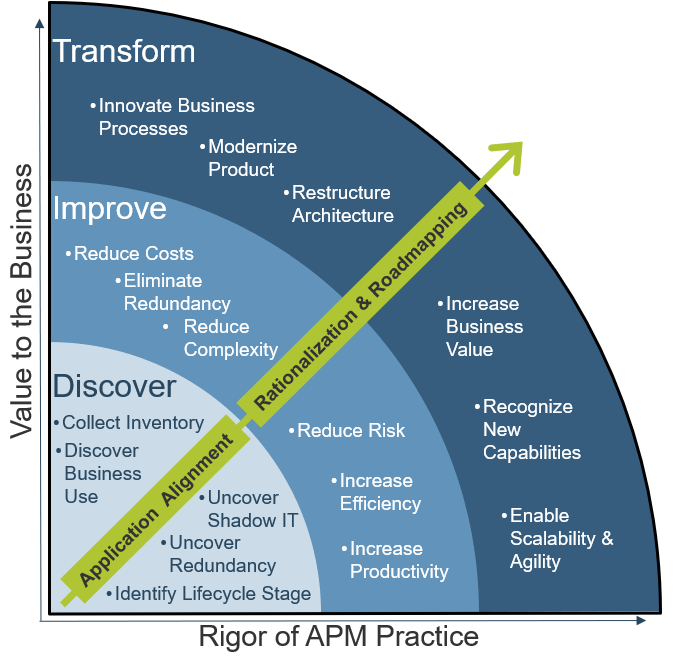
    Een plaatje uit een artikel over applicatierationalisatie zegt echter wat u te doen staat: DISCOVER, IMPROVE en TRANSFORM.

    DISCOVER: waar staat uw bedrijf

    IMPROVE: ruim drempels op

    TRANSFORM: ga de uitdaging aan, verander je business en zoek dan de oplossing die daarbij hoort

    Do you curl up in a corner and wait for the hype to blow over?

    Global disruptions, burgeoning technologies, changing work cultures, they all don't make it easy for leaders. We need to become more resilient, agile and robust, but what should we do with these hypes?

    Blockchain, cryptocurrencies, metaverse, composable applications, digital operations platforms, cloud-native, single and multi-tenant, DApps - decentralized applications, DeFi - decentralized finance, ...

    A selection of the many concepts that C-suite leaders have to deal with. I guess, even for less you'd hide a corner somewhere far away. After all, the experts who can help you have yet to be born.

    In the open online course "What Can Blockchain Do For You?" Lloyd Keays lifts a corner of the veil on how blockchain technology works and whether it can be used in business.

    Arun Maharajan, blockchain lead at UNICEF Innovation, in part 2 of the course, answers the question: "What are the risks, difficulties and roadblocks when working with blockchain?".

    We can broaden this question. "What are the risks, the possibilities and impossibilities, the roadblocks, the opportunities and threats, of all these concepts for business?" AND moreover "Who is still able to give the right advice and/or make choices for the future?"

    In his answer he makes an important statement "The whole industry goes through a lot of hype". This statement typifies what we see happening today. International and national research and consultancy firms approach these concepts from different angles.

    Gartner, the future of companies and solutions is composable, Forrester pushes Digital Operations Platforms (DOPS). Essentially, they all say the same "we need to move to cloud-native platforms that support intelligence, low- and no-code, privacy out-of-the-box, are composable and all connected".

    Vendors with solutions build with and on top of Cloud-native development platforms such as Acumatica, Ramco Systems, NetSuite, Salesforce, SAP and Microsoft (not yet, neither BC nor FSCM are built with the Power platform) are at the top of the list.

    Arun Maharajan ends with "There's a lot of hype cycles, a lot of press, which always creates mixed results. So that doesn't always work in our favor".

    A picture from an article on application rationalization tells you what to do: DISCOVER, IMPROVE and TRANSFORM.

    DISCOVER: where does your company stand

    IMPROVE: remove barriers

    TRANSFORM: take on the challenge, change your business and then look for the appropriate solution

    How do Single- and Multi-Tenancy, Cloud-Native and Born in the Cloud differ!

    You probably wonder why I am assembling this overview of definitions. Now the explanation is very simple, lately I have been reading the latest publication / report from Gartner about "Cloud ERP for Product-Centric Enterprises". [Gartner: see references]

    A lot of terms are used in the report that made me doubt if I really understood these concepts properly.

    Multi-Tenant versus Single-Tenant

    ☛ What is Multi-Tenant Architecture? [Datamation: see references]

    Multi-tenant architecture, commonly referred to as multitenancy, is a software architecture in which multiple single instances of software run on a single physical server.

    The server then serves multiple tenants.

    Additionally, multitenant architecture is used to enable multiple users to use a single application, for instance a database.

    “Tenants” is a term for a group of users or software applications that all share access to the hardware through the underlying software.

    Multiple tenants on a server all share the memory, which is dynamically allocated and cleaned up as needed. They also share access to system resources, such as the network controller.

    This is the opposite of single-tenancy, in which the server runs one instance of the operating system and one application.

    Multi-tenant architecture’s core advantage is that it allows exponentially more use from a single hardware or software platform.

    What Is The Difference Between Single And Multi-Tenant?

    Single-tenancy is largely seen as the “deluxe” option, in that a client operates in a solely dedicated environment.

    In a multi-tenant environment, each customer shares the software application along with a single database, so multiple people from the same company can access the database.

    Still, even in multi-tenant, each tenant is isolated from other tenants.

    ☛ WHAT IS THE DIFFERENCE: SINGLE TENANT VS MULTI-TENANT [Digital Guardian: see references]

    Single Tenant

    A single instance of the software and supporting infrastructure serve a single customer. With single tenancy, each customer has his or her own independent database and instance of the software. Essentially, there is no sharing happening with this option.

    Multi-Tenantancy

    Multi-tenancy means that a single instance of the software and its supporting infrastructure serves multiple customers. Each customer shares the software application and also shares a single database. Each tenant’s data is isolated and remains invisible to other tenants.

    ☛ Single Tenant vs Multi Tenant: SaaS Architecture [ClickIT: see references]

    Today we’ll break down the differences between single tenant vs multi tenant architectures.

    The main difference between them is that these software applications can serve either one or more customers at the same time.

    Single Tenant Architecture

    Single tenant architecture uses a software application and a database for each tenant (client).

    What this means is that clients can’t share the database or application between them, because all of them have their own instances of database and applications.

    We’ll try to explain how the single tenant structure system works by providing you with the real estate example, which should be easy enough to understand.

    Imagine that every client has its very own office building.

    All these buildings are located on the same street. The street represents the same server from which all the SaaS clients operate.

    Every client runs its operations from within their buildings. The buildings are lined-up next to each other on the street.

    Multi Tenant Architecture

    We’ll use the same descriptive method of the above real estate example for multi tenant architecture.

    Multi tenant architecture can be described as the environment in which clients are offices, but, in this case, all of the offices (clients) are located within the same building.

    Every client works from its own space within a large SaaS software product, making it much more comfortable and more accessible in some cases.

    The multi tenant approach models are divided into:

  • Logical Data Separation is a model that allows all tenants the possibility to utilize only one database. All of their data is securely separated within the same database by implementing unique identifiers for every client. The codebase is responsible for retrieving and storing the data via this unique identifier.
  • Physical Data Separation is another model that will successfully separate the data by utilizing different databases for different clients (tenants). Doing so helps people scale the application following the client’s growth and will also scale the application according to the clients’ needs.
  • Cloud-Native versus Born in the cloud

    ☛ What is Cloud Native? [Microsoft: see references]

    Let's start with a simple definition:

    "Cloud-native architecture and technologies are an approach to designing, constructing, and operating workloads that are built in the cloud and take full advantage of the cloud computing model."

    The Cloud Native Computing Foundation provides the official definition [CNCF: see references]

    "Cloud-native technologies empower organizations to build and run scalable applications in modern, dynamic environments such as public, private, and hybrid clouds. Containers, service meshes, microservices, immutable infrastructure, and declarative APIs exemplify this approach.

    These techniques enable loosely coupled systems that are resilient, manageable, and observable. Combined with robust automation, they allow engineers to make high-impact changes frequently and predictably with minimal toil."

    The pillars of cloud native

    The speed and agility of cloud native derive from many factors. Foremost is cloud infrastructure.

    But there's more: Five other foundational pillars shown in Figure 1-3 also provide the bedrock for cloud-native systems.

    Figure 1-3. Cloud-native foundational pillars

    Microservices

    Cloud-native systems embrace microservices, a popular architectural style for constructing modern applications.

    Built as a distributed set of small, independent services that interact through a shared fabric, microservices share the following characteristics:

  • Each implements a specific business capability within a larger domain context.
  • Each is developed autonomously and can be deployed independently.
  • Each is self-contained encapsulating its own data storage technology, dependencies, and programming platform.
  • Each runs in its own process and communicates with others using standard communication protocols such as HTTP/HTTPS, gRPC, WebSockets, or AMQP.
  • They compose together to form an application.
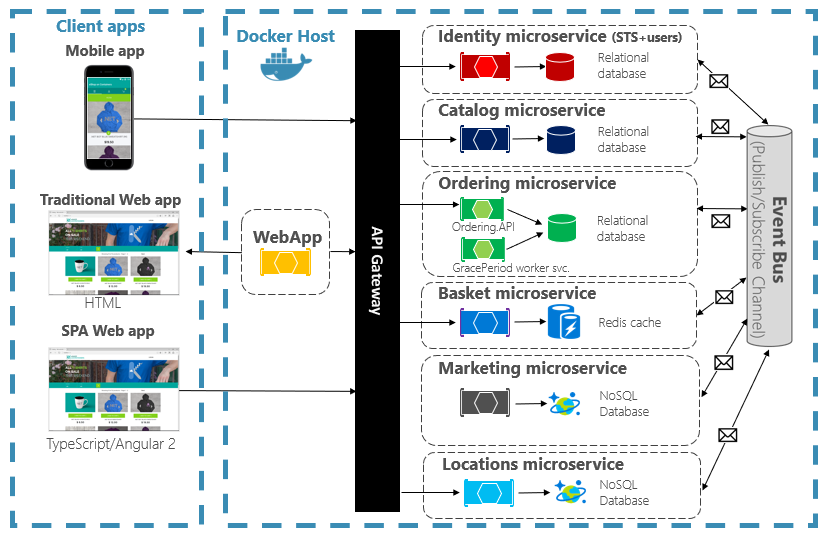
  • Figure 1-4 contrasts a monolithic application approach with a microservices approach. Note how the monolith is composed of a layered architecture, which executes in a single process. It typically consumes a relational database.

    The microservice approach, however, segregates functionality into independent services, each with its own logic, state, and data. Each microservice hosts its own datastore.

    Figure 1-4. Monolithic versus microservices architecture

    ☛ What is cloud native? The modern way to develop software [InfoWorld: see references]

    Cloud-native definition

    Cloud-native is a modern approach to building and running software applications that exploits the flexibility, scalability, and resilience of cloud computing. Cloud-native encompasses the various tools and techniques used by software developers today to build applications for the public cloud, as opposed to traditional architectures suited to an on-premises data center.

    The cloud-native approach to building and running software was pioneered by a group of companies commonly referred to as “born in the cloud” — such as streaming giants Netflix and Spotify, ride-hailing company Uber, and accommodation booking platform Airbnb. The cloud-native approach has since been adopted by other companies looking for similar digital agility and disruptive competitive advantage.

    The Cloud Native Computing Foundation (CNCF) defines cloud-native a little more narrowly, focusing on application containerization — where applications are broken down into microservices and packaged in lightweight containers to be deployed and orchestrated across a variety of servers.

    In the CNCF’s own words: “Cloud-native technologies empower organizations to build and run scalable applications in modern, dynamic environments such as public, private, and hybrid clouds.”

    Cloud-native app development typically includes marrying microservices, cloud platforms, containers, Kubernetes, immutable infrastructure, declarative APIs, and continuous delivery technology with techniques like devops and agile methodology.

    ☛ Cloud-Based, Cloud-Native, and Cloud-Enabled Applications — What fits your business? [ISHIR: see references]

    Cloud-native application: Cloud-native applications are architected for the public cloud. Due to being designed specifically for the cloud, it can harness the full power of cloud using cloud-based technologies. These are made on the microservice architecture and comprise continuous integration, container engines, and orchestrators, making them highly flexible and scalable.

    Cloud-enabled application: Cloud-enabled application is any traditional app developed in a legacy system and then upgraded to work in the cloud. These apps were initially intended to operate on-premise, with local resources and hardware, but later migrated to the cloud, where they use the virtual resources and inherent capabilities of the cloud to gain the cloud advantage.

    Cloud-based application: Cloud-based apps serve as a hybrid – the best balance between cloud-native and cloud-enabled. A cloud-based application doesn’t need infrastructure upgrades, but it also doesn’t run to the fullest power like a cloud-native app. Essentially, it leverages the capabilities and resources of the cloud to run the app without the need for a complete overhaul.

    Referenties

    ✅ Three Composable Commerce Myths [Jason Cottrell]

    ✅ Enterprise suites are no longer “the safer choice." The MACH ecosystem is. It is agile and nimble, always up to date. [MACH Alliance]

    ✅ What is a Platform Ecosystem? [Partner Fleet]

    ✅ What Is Composable ERP? [RootStock]

    ✅ Staan NetSuite en Microsoft ERP/WMS al op uw WishList? (12 juni 2022)

    ✅ Het Gartner® Magic Quadrant™ for Product-Centric Enterprises - editie 2022 [Gartner]

    😍#mensenwerk met een vleugje #technologie😏
    Composable Commerce / ERP Myths

    Als we het over een Composable Commerce / ERP strategie hebben dan adviseer ik om het artikel "Three Composable Commerce Myths" van Jason Cotrell te lezen [Link: zie referenties].

    Het artikel werpt een interessant licht op de term composable Commerce en tevens op de term composable ERP.

    Volgens Jason profiteren momenteel verschillende monolithische spelers van de kracht en waarde die composable principes organisaties brengt. Zij doen dat door API's te implementeren die Headless of zelfs Composable lijken.

    Om leiders van ondernemingen te helpen in hun zoektocht naar de juiste oplossing voor hun bedrijf heeft Jason drie misvattingen, die hij dagelijks voorbij ziet komen, uit de doeken gedaan.

    Myth 1: Headless is composable.

    Myth 2: Monoliths can be headless.

    Myth 3: Composable is always the best choice.

    Ik wil een paar statements uit zijn artikel de revue laten passeren, temeer omdat het advies- en onderzoeksbureau Gartner Composability een belangrijk item vindt voor de komende jaren.

    Zo verwacht Gartner dat "Tegen 2024, meer dan 60% van de organisaties cloud-ERP zal inzetten als een ecosysteem bestaande uit applicatie- en technologieplatforms van meerdere leveranciers.".

    In mijn artikel over het "Gartner® Magic Quadrant for Cloud ERP for Product-Centric Enterprises (editie 2022)" bespreek ik uitgebreid de visie en andere aspecten van een Composable ERP. [Link: zie referenties, verschijnt binnenkort]

    Enkele belangrijke statements van Jason:

    ☛ Composable Commerce / ERP beschrijft een architectuur-principe in plaats van een specifieke technologie

    ☛ Standaarden zijn nog niet beschikbaar maar door initiatieven van organisaties als de MACH Alliance en andere technologie-bedrijven gaan deze zeker op termijn ontstaan. [Link: zie referenties]

    ☛ Alles-in-één-platformen kunnen slechts composable zijn binnen de grenzen van hun architectuur. Wat wil zeggen dat "pure composability" over platformen heen vooralsnog een utopie is als het gaat over Commerce of ERP oplossingen.

    Alles-in-één platforms zijn als gekookte spaghetti

    John Stewart, VP Corporate Marketing, Algolia, schrijft in het artikel waarnaar Jason verwijst het volgende over alles-in-één platformen:

    "Alles-in-één platforms zijn als gekookte spaghetti - diensten zijn met elkaar verstrengeld. Wanneer meerdere technici op hetzelfde platform werken, kan het rommelig worden.

    Stel dat iemand het bestelsysteem verandert. Dat heeft gevolgen voor het uitchecken, de afhandeling, het voorraadbeheer en nog een dozijn andere services.

    Aan de andere kant zijn composable ondernemingen als ongekookte spaghetti. Elke microservice staat op zichzelf. "Elk onderdeel van de functionaliteit is anders", legt Shiferman uit. “Je hebt duidelijk omschreven contracten. Je kunt echt alles op een zeer gedetailleerd niveau beheren.” Omdat elke functie anders is, kun je 50 mensen allemaal op hetzelfde platform laten werken zonder dat alles chaotisch wordt.

    "Je moet uitzoeken hoe je zakelijke gebruikers op verschillende manieren kunt ondersteunen", zegt Alex Shiferman, CTO van Nuts.com.

    the composable enterprise is as Lego

    Zie de composable enterprise als Lego, zegt Shiferman. In plaats van één complete tool te kopen - een e-commerceplatform, een financieel systeem, een projectmanagementtool, wat dan ook - koop je bouwstenen. Wanneer je een nieuwe tool nodig hebt, combineer je blokken om iets op maat te maken voor jouw organisatie.

    “If I buy a dollhouse for my daughter, it comes fully built,” he continues. “But if I buy a Lego dollhouse, she can move things around and make it really her own.”

    de kracht van een composable ERP ligt in het platform ecosysteem

    Composability in de huidige wereld van ERP en bedrijfsapplicaties staat nog steeds gelijk aan best-of-breed TENZIJ bedrijven de bouwstenen die het nodig heeft binnen het platform ecosysteem van de oplossingsaanbieder vindt.

    We spreken over een platform ecosysteem wanneer het product van de leverancier een platform is waar klanten en partners oplossingen mee en/of op bouwen - Partner Fleet. [Link: zie referenties]

    Kanttekening: De kracht van leveranciers die hun ERP oplossing van de grond af hebben ontworpen en gebouwd voor de Cloud zit in hun platform ecosysteem, een Cloud-native development / run-time platform waarmee de oplossing(en) is gebouwd en beschikbaar gemaakt.

    Aanbieders van ERP oplossingen gebouwd met zo'n Cloud-native development / run-time platform - we spreken dan over Platform as a Service (PaaS) - zijn:

    ✔ NetSuite (SuiteCloud®-platform)

    ✔ Acumatica (Cloud xRP Platform) - helaas dit jaar niet opgenomen in het Magic Quadrant.

    ✔ Salesforce (SalesForce Lightning Platform) - geen ERP aanbieder - toch is het interessant om het artikel van RootStock "What Is Composable ERP?" te lezen, RootStock is gebouwd op / met het SalesForce Lightning Platform. [Link: zie referenties]

    ✔ Ramco (VirtualWorks®) - evenals Acumatica niet opgenomen in het Magic Quadrant

    Meer over platform ecosystemen kunt u lezen in mijn artikel "Staan NetSuite en Microsoft ERP/WMS al op uw WishList?". [Link: zie referenties]

    De analisten van Gartner zijn optimisch en verwachten dat "Tegen 2024, meer dan 60% van de organisaties cloud-ERP zal inzetten als een ecosysteem bestaande uit applicatie- en technologieplatforms van meerdere leveranciers.".

    het summum van composability

    Stelt u zich eens voor dat u verkooporders verwerkt in / met Microsoft D365 Supply Chain Managment en de factuur creëert in / met Oracle Fusion Cloud ERP.

    Is dit niet het summum van composability, van een composable ERP? Zullen we ooit een ERP applicatie kunnen samenstellen gebruikmakende van applicatieservices van verschillende leveranciers?

    Wat we daarvoor nodig hebben is een composable data storage benadering die door alle oplossingsaanbieders wordt omarmd.

    Deze vorm van Composability is niet de insteek, de visie, van Gartner. Gartner analisten begrijpen als geen ander dat de gevestigde aanbieders van ERP suites hier voorlopig niet op in zullen gaan.

    Kanttekening: Misschien is dit wat Gartner bedoeld met multitenancy op database- of besturingssysteemniveau.

    Voorlopig is het de wens van Gartner, dat "Tegen 2024, ten minste 50% van de klanten van bestaande ERP-megavendors meerdere leveranciers zullen evalueren, in plaats van automatisch de nieuwste versie van hun bestaande ERP-suite over te nemen.".

    Anders gezegd de ERP mega-suites zullen nog lang blijven bestaan.

    Referenties

    ✅ SaaS: Single Tenant vs Multi-Tenant - What's the Difference? - October 2022 [Digital Guardian]

    ✅ What is Multi-Tenant Architecture? - February 2021 [Datamation]

    ✅ Single Tenant vs Multi Tenant: SaaS Architecture - August 2020 [ClickIT]

    ✅ What is Cloud Native? - July 2022 [Microsoft]

    ✅ CNCF Cloud Native Definition [CNCF]

    ✅ What is cloud native? The modern way to develop software - August 2021 [InfoWorld]

    ✅ Cloud-Based, Cloud-Native, and Cloud-Enabled Applications — What fits your business? [ISHIR]

    ✅ Staan NetSuite en Microsoft ERP/WMS al op uw WishList?

    😍#mensenwerk met een vleugje #technologie😏

    SalesForce Composable Storefront, digitale handelsoplossing om retailers te helpen snel 'headless' te gaan

    SalesForce onthulde maandag haar composable Storefront

    ⏳⛏de H uit MACH = Headless⏳⛏

    De afgelopen twee jaar is Headless het toverwoord geworden maar het is niet nieuw. Het lijkt wel zo maar dat is het niet. In 2015 heb ik een dagje meegelopen met een lead-architect van Thinkwise. Hij liet mij zien hoe zij de front-end van de back-end logica hebben ontkoppeld. Dit maakt het mogelijk om de front-end los van de back-end verder door te ontwikkelen.

    In een tutorial van MuleSoft, onderdeel van Salesforce, uit 2015 over SOAP webservices: "The logic to access and process data from backend systems is baked directly into these front end applications. If there is any change in the backend system, it turns into a very costly exercise to propagate that change to each dependent application."

    Wijzigingen in de back-end van geïntegreerde systemen hebben altijd impact op de front-end. Een gegeven waar veel developers al jaren tegen aan zitten hikken en zoeken naar oplossingen.

    "Having a system API decouples the front end consuming applications from interface changes in the backend enterprise systems, exposes information in your business specific semantics and provides flexibility to make changes with less impact."

    ⏳⛏Composite Applications⏳⛏

    2004 / 2005 het jaar van de opkomst van Composite Applications, de filosofie was precies hetzelfde, een webservices based framework met verschillende layers. Alleen de Cloud-technologie, SaaS platformen, waren er destijds niet of niet volwassen genoeg.

    Nu praten we over MACH: MACH staat voor Microservices based, API-first, Cloud-native SaaS and Headless.

    We gaan de impact van MACH de komende jaren meemaken: van Composable Business tot Composable Architecture en alles wat composable te maken is.

    SalesForce en vele anderen investeren in MACH. Volgens SalesForce moeten retailers in headless commerce investeren om groei te stimuleren.

    📣77% van de commerciële organisaties die een headless-architectuur hebben geïmplementeerd, zegt dat het hen meer flexibiliteit geeft doordat ze snel wijzigingen in hun etalage kunnen aanbrengen

    📣 80% van de bedrijven die momenteel geen headless commerce-technologie hebben, is van plan deze in de komende twee jaar te implementeren

    Met Salesforce Composable Storefront kunnen Commerce Cloud-klanten een headless commerce-strategie implementeren zonder zichzelf bloot te stellen aan aanzienlijke overhead- of complexe ontwikkelingsproblemen.

    Let op: Het delen van data is nog wel een dingetje dat opgelost moeten worden zoals ik deze week beschreef in "Wat is een Cloud-Native Application?" over Composable ERP.

    Tags: MACH, composable architecture, Digital Leadership

    Wat is een Cloud-Native Application?

    Iedereen wordt er de laatste maanden mee geconfronteerd. Monolotische Mega-Suites zijn over hun hoogtepunt heen, ze zijn verworden tot Dinosaurussen. Dinosaurussen, uitgestorven door veranderingen in hun leefomgeving.

    Is dit het lot wat monolitische Mega-suites te wachten staat?

    Denk het niet. De functionaliteiten in mega-suites zijn gebouwd volgens OOP Objected Oriented (modular) Programming principes, ooit een hype. Het is die object-georiënteerde benadering die het makkelijk maakt om deze monolieten op te splitsen in modulaire blokken, Cloud micro-services.

    Een volledig composable ERP, het gaat op korte termijn nog niet gebeuren. Data, en dan vooral gegevens die in verschillende applicaties gedeeld, gebruikt, hergebruikt worden vormen de uitdaging voor het samenstellen van een mega-suite op basis van Cloud-Native Applicaties / Componenten.

    Zo is data de zwakke schakel in een best-of-breed benadering. Uiteindelijk wil je als organisatie, zoals dat zo mooi heet, een seamless integrated experience krijgen zoals tussen ERP en WMS. Door het grote aantal integration touch-points vereist deze experience echter een zware integratie-component.

    📣Intek, "How to Succeed Integrating A WMS Or WCS With An ERP", heeft het over de basis-mechanismes voor het integreren van WMS met ERP: Staging-tabellen, Webservices / API's, en platte bestanden uitwisselen. Staging-tabellen zijn databasetabellen die worden gedeeld en die zich in één van de oplossingen bevinden.

    📣SCJUNCTION, Manhattan Software specialist, "The Core Considerations of Integrating a WMS with your ERP", heeft het over Point-to-Point integratie, Middleware en Shared Components.

    Shared Components en staging-tabelen, de pluggable apps benadering, modules die kunnen worden aan- of uitgezet, of toegevoegd. De app-stores, app-marketpaces van SalesForce, NetSuite en Microsoft, wie kent ze niet. De data verblijft dan in het development - platform, het eco-system.

    De aanpak van SalesForce met haar Lightning Platform spreekt me meer aan dan die van Microsoft. Een applicatie zoas RootStock ERP kan volledig standalone draaien naast SalesForce CRM.

    Zo kent Oracle NetSuite met haar NetSuite Cloud platform ook een heel sterke aanpak. Zie mijn artikel "Staan NetSuite en Microsoft ERP/WMS al op uw WishList?"

    ⏳⛏Back to the subject⏳⛏

    Cloud-Native Applications, de aanleiding voor mijn bedenkingen is een recent artikel van Microsoft over de overgang van monolitische naar Cloud-Native Apps, "Introduction to cloud-native applications".

    "Many organizations have addressed this monolithic fear cycle by adopting a cloud-native approach to building systems."

    In het nieuwe Cloud-Native Design is de monoliet opgesplitst in kleine stukjes Cloud micro-services die los van elkaar met een eigen database (NOSQL of relational) samengesteld kunnen worden tot een werkende applicatie.

    De "flaw" in het design, de database, noodzaakt tot verblijven op éénzelfde Cloud-platform.

    Tags: Digital Leadership, ERP, composable architecture, MACH